Ant Communication Secrets

Pankaj Singh
| 07-04-2026
 · Animal Team
Watching ants scurry along a trail can feel like witnessing a perfectly synchronized ballet.
Yet beneath this apparent chaos lies a hidden language that governs their every move.
Ants communicate primarily through chemical signals called pheromones, allowing them to coordinate tasks, locate food, and protect their colonies efficiently. Understanding this subtle system reveals the sophistication of one of nature's tiniest social networks.
What Are Pheromones?
Pheromones are chemical compounds secreted by ants to convey messages to other members of their colony. Each pheromone serves a specific purpose, from marking trails to signaling danger. For example, a foraging ant leaving a food source will deposit a trail pheromone that others can follow back to the nest.
Types of Pheromones
Trail pheromones – guide ants to resources.
Alarm pheromones – warn colony members of threats.
Recruitment pheromones – signal the need for more ants to a specific task.
Nest recognition pheromones – help ants identify their home.
Actionable example: In an observation setup, placing a small sugar source in an ant habitat and tracking their trails can visually demonstrate how trail pheromones guide other ants directly to the food.
Trail-Laying Behavior
Trail pheromones are one of the most remarkable tools ants use. A single ant will deposit chemicals as it moves, creating a path for others to follow. These trails are dynamic: if a route becomes inefficient, ants naturally abandon it, and the pheromone evaporates over time, allowing colonies to adapt to changing conditions.
How Trails Influence Efficiency
Shorter paths accumulate stronger pheromone signals.
Longer or blocked paths fade, reducing traffic.
Ants collectively optimize routes without centralized control.
Example: When observing garden ants, you might notice that after placing an obstacle along a sugar trail, ants quickly find and reinforce an alternative path, demonstrating adaptive trail use.
Alarm Signals and Colony Defense
Alarm pheromones trigger rapid responses to danger. When a threat approaches, affected ants release a chemical that alerts others to prepare for defense or retreat. The intensity of the alarm depends on the urgency of the situation.
Practical Observation Tips
Slightly disturb a foraging ant (safely) to observe rapid colony reactions.
Note how ants change their pace or alter routes in response.
Understand that these signals protect the colony from potential harm.
Example: In a controlled observation, lightly tapping the surface near a foraging ant may cause nearby ants to gather or scatter, showing the immediate effect of alarm pheromones.
Recruitment for Tasks
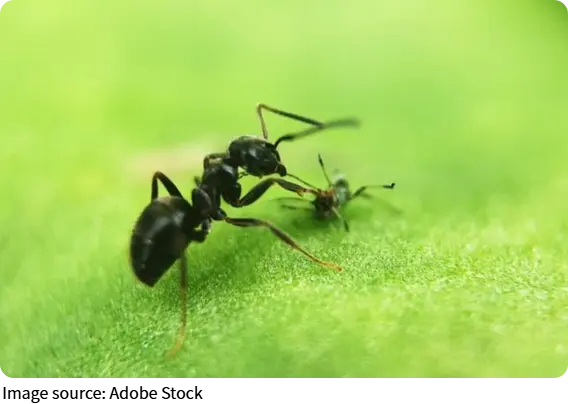
Ants use recruitment pheromones to signal the need for extra workers on specific tasks, such as carrying large food items or defending a vulnerable part of the nest. A foraging ant encountering a heavy object may release chemicals to attract more ants, enabling coordinated lifting.
Step-by-Step Recruitment
Ant encounters a task beyond its capability.
Releases recruitment pheromone along its return path.
Other ants detect the signal and follow to assist.
Example: In an educational ant farm, placing a large crumb in the enclosure encourages multiple ants to collaborate, illustrating chemical recruitment in action.
Maintaining Colony Organization
Beyond foraging and defense, pheromones help maintain nest structure and social order. Nest recognition pheromones allow ants to distinguish colony members from intruders. They also help regulate roles within the colony, such as workers, defenders, and caretakers, without verbal or visual communication.
Colony Management Insights
Pheromone signals prevent conflicts and maintain harmony.
Chemical cues guide young ants to care for eggs and larvae.
Signals adapt over time, reflecting changes in colony priorities.
Example: By observing ants moving between different nest chambers, one can see how pheromones guide traffic and prevent overlap between tasks.
Ant pheromone communication demonstrates that even tiny creatures can execute complex social behaviors without spoken words. By following trails, responding to alarms, and coordinating labor, ants maintain an incredibly organized society. Observing these interactions up close not only reveals the elegance of their chemical language but also reminds us of the intricate strategies life has evolved to thrive in every environment.
Watching ants navigate, signal, and organize is a lesson in silent teamwork—proof that communication comes in many forms, often hidden in plain sight.