Brush Textures Explained
Matteo
| 08-09-2026
 · Art Team
Hello, let's get started. Most people pick up a brush and assume it's just a stick with some hairs on the end.
But the moment you drag a flat brush across wet paper versus a round one, you'll see the surface transform in completely different ways. That's not a flaw, it's the whole point.
Why bristle type matters first
Think about what the brush is made of before you even worry about its shape. Natural hog bristle, like the kind in a classic bristle brush from brands like Winsor & Newton, is stiff and rough. It leaves visible tracks in thick oil paint, perfect for pushing pigment around and creating that textured, almost rugged look. On the flip side, a synthetic sable brush, or a real kolinsky sable if you're willing to spend, holds a fine point and glides smoothly. You'll get clean, even washes with no streaks at all.
Flat brushes build bold surfaces
A flat brush, with its squared-off tip, is your go-to for covering large areas with a consistent texture. Run it across a canvas loaded with acrylic and you'll get crisp, straight edges and a smooth, uniform layer. But twist it slightly as you glide, and suddenly the edge leaves a jagged, broken mark. That's why many landscape painters, like those working in the style of Bob Ross's wet-on-wet technique, use flats to lay down broad sky areas, then switch to a smaller flat to carve out mountain ridges with a single decisive press.
Round brushes give you control
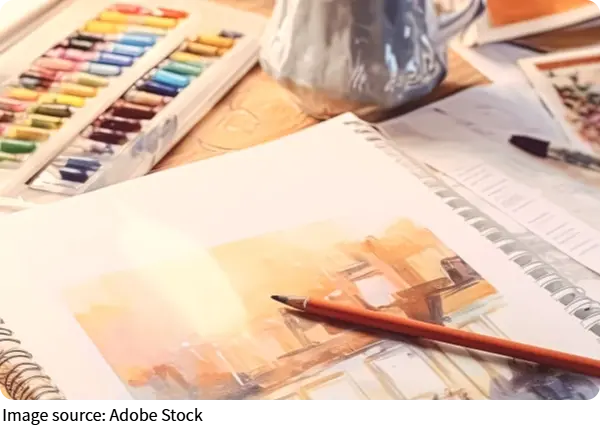
Round brushes taper to a point, which makes them the most versatile tool in your kit. A size 6 round can lay down a thin, delicate line for a branch one moment, then press down firmly to deposit a thick drop of color the next. Watercolorists lean on rounds heavily because the tip lets you paint tiny details like the veins on a leaf or the glint in an eye without switching tools. The texture here is less about the brush itself and more about how much water you load it with; a dry round brush drags across paper leaving rough, grainy patches, while a wet one flows out into soft, feathery blooms.
The fan brush is a texture shortcut
If you want grass, fur, or clouds without painting every strand, a fan brush does the heavy lifting. Its spread-out bristles in a fan shape let you dab or sweep lightly, and the paint breaks apart naturally. Oil painters use it to soften edges on portraits, like blending the transition from cheek to shadow. But here's the catch: it's easy to overuse. A fan brush can make your work look gimmicky if you rely on it for everything, so treat it as an accent, not a main tool.
Texture changes with pressure and angle
You don't always need a new brush to change how a surface feels. Hold your brush more upright, almost perpendicular to the canvas, and you'll deposit paint only at the very tip, creating stippled, dotted textures. Flatten the brush out, nearly parallel to the surface, and you'll smear a thin, dragged layer that lets the tooth of the canvas show through. Try this with a stiff bristle brush loaded with dry paint on a rough surface like linen, and you'll get a scratchy, broken effect that screams energy. On a smooth surface like hot-pressed watercolor paper, the same brush will glide and leave almost no texture at all.
Wash brushes reward patience
For large, soft areas like backgrounds or skies, a wash brush is your best friend. These are wide, flat brushes, sometimes as broad as two inches, made to hold a lot of liquid. In watercolor, a wash brush lets you lay down a smooth, even layer of color that dries without hard edges, provided you work quickly. Acrylic painters use them for glazing too, where a thin, transparent layer of paint sits over a dried one to shift the tone subtly. The texture here is almost invisible, which is exactly what you want; it's about creating a calm, seamless surface that lets other details pop.
The real skill isn't owning a hundred brushes, it's knowing what each one does when you push it across the surface. Next time you're in the studio, grab a flat and a round, load them with the same paint, and make a few strokes on scrap paper. Feel the difference in your hand, not just your eyes. That's the fastest way to learn, and honestly, it's the most fun part of painting anyway.